Prof. Tamar Zewi
Prof.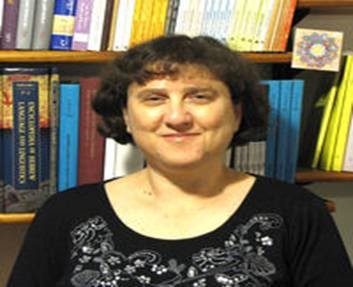 Tamar Zewi Prof. Zewi serves as faculty member in the Department of Hebrew Language at the University of Haifa, and as Head of the Joseph & Racheline Barda Chair for the Study and Research of Jewish Heritage in Egypt (http://srjhechair.haifa.ac.il/index.php/he/). Tamar Zewi’s academic interests include Hebrew and Semitic linguistics and philology. Her current research projects include Saadya Gaon’s translations of Scripture according to early manuscripts including Genizah fragments.
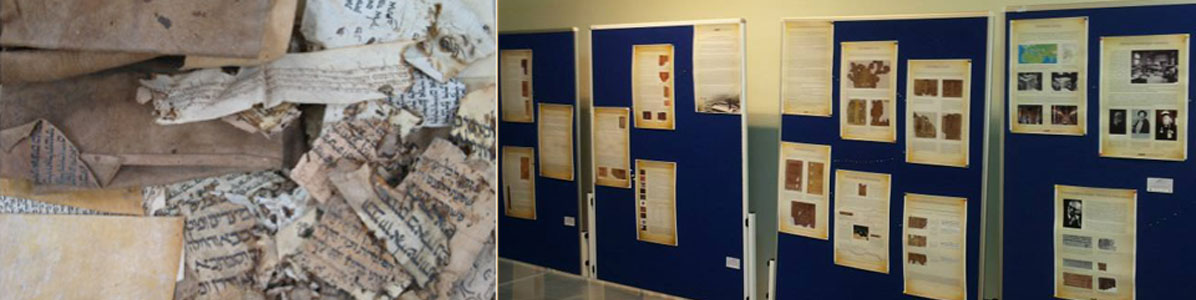
In 2014-2016, Prof. Zewi has conducted in collaboration with Dr. Barak Avirbach and Dr. Mikhal Oren a research project “The Samaritan Version of Saadya Gaon’s Translation of the Pentateuch” that was funded by the Israel Science Foundation (ISF grant 18/09). And is currently conducting in collaboration with Dr. Amir Ashur and Dr. Barak Avirbach a research project, “Early Genizah Fragments of Saadya Gaon’s Translation of the Pentateuch”, also funded by the Israel Science Foundation (ISF grant 150/15)
Published work which incorporates Genizah material:
Zewi, Tamar. 2015. The Samaritan Version of Saadya Gaon’s Translation of the Pentateuch. (Biblia Arabica: Texts and Studies 3). Leiden: Brill.
Zewi, Tamar. 2014. “Proper Names in the Samaritan Version of Saadya Gaon’s Translation of the Pentateuch.” Ben ‘Ever La- ‘Arav 6: 97-108. (in Hebrew).
Zewi, Tamar. 2014. “Aramaic Component and Aramaisms in the Arabic Column of Ms. BL OR7562.” Aramaic Studies 12: 154-167.
Zewi, Tamar. 2016. “Samaritan Arabic Translations.” In: Lange, A. & Tov, E. eds. Textual History of the Bible, V.1A. Leiden: Brill: 309-315.
Zewi, Tamar. 2016. “Proper Nouns in the Samaritan Version of Saadya Gaon’s Translation of the Pentateuch.” Journal of Semitic Studies 61: 139-155.
Zewi, Tamar. 2016. “The Samaritan Version of Saadya Gaon’s Translation of the Pentateuch.” Ginzei Qedem 12: 113-126. (in Hebrew).
Homepage:
http://research.haifa.ac.il/~
https://haifa.academia.edu/
 Dr. Simonsohn is a lecturer in the Dept. of Middle Eastern History in the university of Haifa. He is a member of the I Core Center for the Study of Conversion and Inter-Religious Encounters, based at Ben Gurion University. Uriel Simonsohn’s academic interests pertain to the individual and shared histories of confessional groups from as early as the Christianization of the Roman Empire to as late as the high Middle Ages in the vast region between the Iberian Peninsula and the Iranian plateau. He is particularly interested in examining the ways in which individuals and groups sustained their confessional identity in the context of their affiliation to a plurality of social circles. His publications touch upon the various encounters between the adherents of the three monotheistic traditions in cultural, religious, and social intersections. Currently Dr Simonsohn is working on two research projects: the role of women as agents of religious knowledge and practice in the early Islamic period, and the role of converts to Islam as cultural brokers.